



The 1980 Gold Crash
1. ⚙️ SEO METADATA (Website Backend Ke Liye)
| Field | Content |
| SEO Title (H1) | ⚠️ 1980 Gold Price Crash: Can Silver and Gold Collapse in 2025? (The Volcker Shock) |
| Meta Description | Gold & Silver are up 60%, but a 68% crash happened in 1980. Learn the story of the Volcker Shock, the geopolitical crises, and the crucial lessons for today’s gold investors. |
| Focus Keywords | Gold Price Crash 1980, Gold Market Collapse, Volcker Shock, Gold Silver Forecast 2025, Investing Lessons, Geopol |
⚠️ 1980 Gold Price Crash: Can Silver and Gold Collapse in 2025? (The Volcker Shock)
Right now, everywhere you look, Gold and Silver are the only topics trending. Everyone is asking: Will this rocket keep flying, or is a crash imminent?
If we call 2025 the Year of Gold and Silver, it wouldn’t be wrong. Both metals have jumped over 60% in a year—a totally unexpected rally. Every news channel, every YouTube video, every social media reel is saturated with “Gold, Gold, Gold.”
The question is: Will this trend continue, or will history repeat what happened in 1980?
💥 The Great Gold Crash of 1980: A 68% Correction
The current excitement on the street is exactly what was happening in 1980. If you feel the FOMO to buy Gold right now, this story might calm your nerves. Gold has already given investors this jolt once before: a devastating 68% crash.
- The Vibe: The environment was exactly the same—a global obsession with rising metal prices.
- The Disaster: The 68% crash financially destroyed many.
- The Lesson: This was the largest Gold Crash in economic history. It was a story of Greed, Fear, and Power—and it holds a life-changing lesson for today’s investors.
🌪️ Scene 1: Gold’s All-Time High and the Three Storms
In 1980, Gold hit an all-time high of $850 per ounce. Adjusted for inflation, that’s equivalent to the prices we see today. But three major geopolitical storms fueled this historic peak:
A. The Crude Oil Blast: The Flight to Safe Haven
- The Event: The 1978-79 coup in Iran removed Shah Reza Pahlavi. Oil production completely collapsed.
- The Impact: The world lost 7% of its oil output. The price of oil skyrocketed from $13 to $34 per barrel.
- The Gold Reaction: Expensive energy fuels inflation. When inflation rises, people flee to safe-haven assets like Gold. Fear mounted, demand surged, and inflation hit the roof.
B. Russia vs. Afghanistan: The Cold War Escalation
- The Event: On top of the Oil Crisis, the Soviet Union (USSR) invaded Afghanistan in 1989.
- The Impact: This was during the height of the Cold War. The US-USSR standoff escalated the geopolitical risk globally. Headlines screamed about World War III.
- The Gold Reaction: Investors always run to Gold during war or global crises to protect their investments. The demand for Gold became manic.
C. The Iran Hostage Crisis: US Directly Involved
- The Event: The biggest shock: Iranian revolutionaries seized the US Embassy in Tehran in November 1989, taking 53 American citizens hostage for 444 days.
- The Panic: With the Soviet Union already fighting in Afghanistan, the fear of a new war between the US and Iran brought the global market to its knees.
- The Gold Rush: Investors feared economic collapse and dollar weakness. Gold, which was $200/oz in 1978, surged 126% by 1980 due to panic buying.
This panic created the same environment we see today: TV experts predicting Gold will hit $1500, $2000, $3000—the same FOMO that drives record highs.
💣 The Volcker Shock: The Hammer that Hit Gold
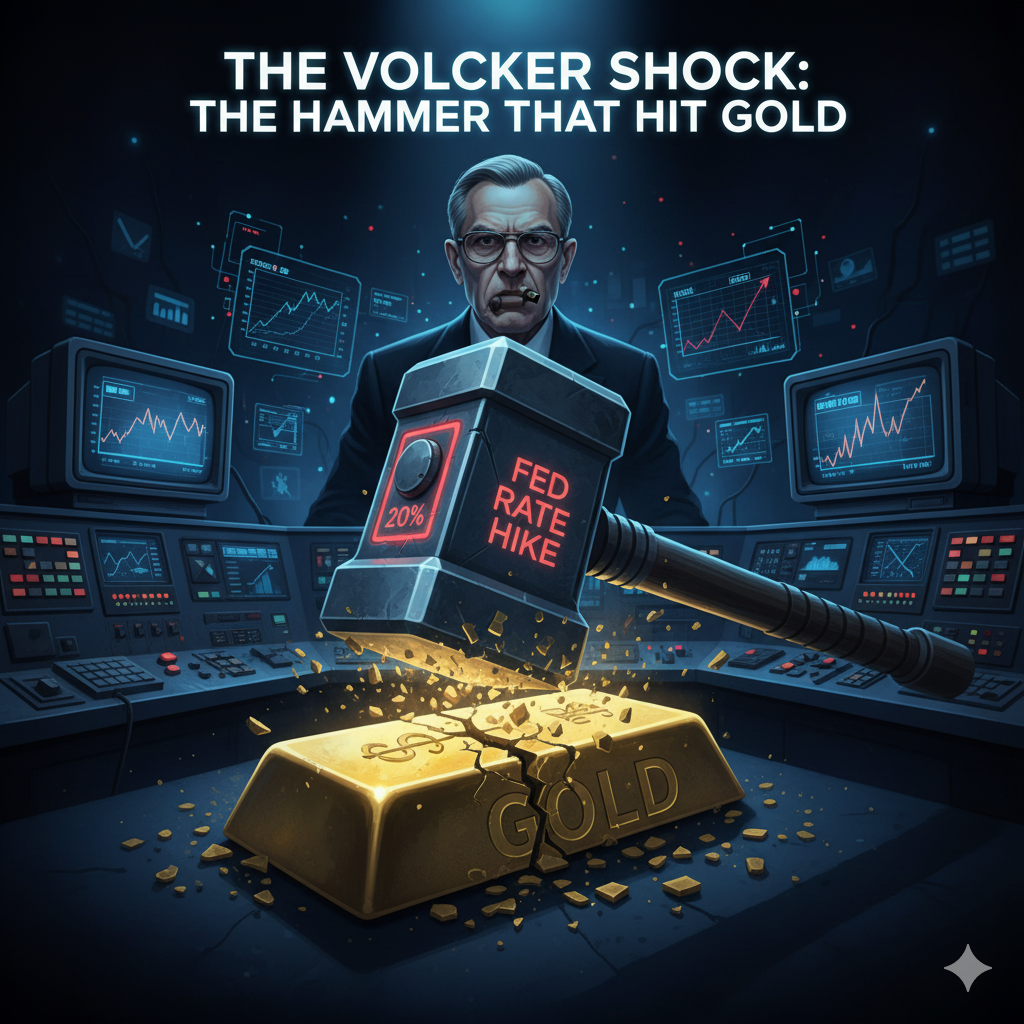
Behind the shining Gold price, the US economy was struggling. The Dollar was weak, and the Fed’s low interest rate policy had fueled massive inflation, reaching a peak of 13.5%. This was a major headache for the US Central Bank.
- The Player: Enter Paul Volcker, the then-Chairman of the Federal Reserve, known as the “Slayer of Inflation.”
- The Move: The Fed signalled strict control on the money supply.
- The Volcker Shock: The Fed raised rates drastically, from 11% to a crippling 20%.
This hammer blow instantly dulled Gold’s shine.
Understanding the Non-Yielding Asset
Gold is a Non-Yielding Asset—it doesn’t pay interest. Its value only increases when the price goes up. But when banks start offering 15-20% interest, holding Gold becomes less attractive. Investors quickly realized: Why hold Gold when I can get 20% interest in a Bank FD or Bonds?
- The Crash: Panic selling began. By the end of 1980, Gold dropped below $600. Those who entered late were ruined.
- The Aftermath: The Gold market remained in a Bear Market for 20 years (1980 to 2001), falling from $850 to $271—a 68% loss.
💡 5 Life-Changing Lessons for Today’s Investor (H2)
As Gold sits at a new record high in 2025, the 1980 lesson is crucial.
- Market Timing is Impossible: No one can accurately predict asset prices. All predictions are just educated guesses, not certainties.
- Diversification is Essential: Never allocate all your savings to a single asset like Gold. Spread your money across different asset classes.
- Central Bank Policy Power: The Central Bank (Fed) holds ultimate power. A sudden policy change (like a massive rate hike) can crush non-yielding metals overnight.
- Geopolitical Events are Short-Term Drivers: Wars and crises drive prices up fast, but the fundamental economics often dictate the long-term trend.
- What Goes Up, Must Come Down: Remember this universal law. Every bubble, driven by FOMO, eventually bursts.
I cannot say the exact same catastrophe will happen again. But I can make you aware that History does not repeat itself, but it certainly rhymes.